Updated 20 September 2026 · Credit packs against a monthly studio

YuE2 vs Suno V6

Both write a complete song with vocals from your lyrics and a style prompt. On the published 192-prompt comparison YuE2 leads the SongBench average; Suno V6 leads on SongEval, caption alignment and pronunciation. The bigger difference is how you work: YuE2 charges credits per song and lets paid packs download without a monthly cap, while Suno V6 is a subscription studio that rewrites a chorus in place.

Where YuE2 is the better buy

You have the words and a direction, you expect to try several full versions, and you want to keep the files. Paid packs include a commercial licence, Starter includes downloads, and Basic and Plus download without a monthly limit.

Where Suno V6 is the better buy

You want to fix one chorus rather than regenerate a song, start from an image or a video, build a mashup from two tracks, or pull stems inside the same app. That editing surface is larger than ours and it is the honest reason to subscribe.

What the scores do not settle

The top five settings sit inside roughly 0.25 of one automatic aggregate, and the authors decline to call the gaps significant. No listener vote is involved. Treat the numbers as context and let the six songs below do the deciding.

What we measured, what we cite

A comparison page is only useful if you can tell our own testing apart from everyone else’s. Three tiers run through this page, and every claim below belongs to one of them.

Our own testing
Twelve English works generated for the YuE2 review at a fixed seed, with measured audio length, inference time, GPU memory, automatic transcript discrepancy, loudness and true peak. Plus a 99-song library across 69 genres and 6 languages, and 11 cover and editing demos.
Published scores
The 12 September 2026 comparison: 192 prompts, 17 settings, nine automatic metrics, with the candidate-selection protocol stated alongside the table. We quote it and we quote the rows we lose.
Other people’s listening
A 17 September 2026 genre-by-genre A/B and early community impressions. These are attributed opinions about how the two sound, not our measurements, and we mark them that way.

Suno audio on this page plays in Suno’s own embed, generated from the same lyrics as our cards. All six pairs carry a Suno run, but four of the six gave Suno a longer style brief than ours, so each card states its own parity and you can discount it where the match is weak. Neither side is a best-of, and we ran no blind listening panel, so we do not declare a winner per song.

Which one fits the song you are making

Averages hide the answer people actually want. These five situations are where the two products separate, drawing on our own test set and on a published genre A/B.

A lyric-led song, verse to chorus to bridge

Close call

Our English baselines hold their structure and land the chorus, and an external A/B on narrative hip-hop found the gap came down to refinement rather than quality. If you already have finished words, either tool will give you something to judge.

Instrumental beds, grooves and driving rhythm

YuE2 holds up

Groove-led and instrumental material is where the same A/B found the open comparison most convincing. Our jazz, funk and country examples are the ones to audition for this.

Big dramatic production and theatrical vocals

Suno V6

Arena-scale builds and overblown delivery are the reported weak spot on our side, and pushing settings harder returns less than you expect. If the song lives or dies on drama, subscribe and test there.

Restyling a song you already know

Depends on what you supply

Suno treats cover, remix and mashup as one-click actions. On our side, fidelity tracks what you give the model: the published cover test collapses from 0.647 to 0.006 on song identity when no musical structure is supplied. Reference audio guides a rendition; it does not lock a melody.

Lyrics in Chinese, Japanese, Spanish or Korean

Audition ours first

Most Suno comparisons never test this. Our library spans six languages, so the two non-English cases below exist specifically for you to check pronunciation and phrasing before spending credits.

Six songs, side by side, with our read on each

Four come from our measured review runs at seed 831001; two are official model demos, included because our review tested English only. Every card states the brief, how closely the two runs were matched, our head-to-head read, and the limit we will not argue past, with a Suno run of the same lyric playing in Suno’s own embed.

Our read compares what each run does with the brief: length against word count, where sections land, how words sit in the mix. It is not a blind listening panel and not a ranking, because a single candidate per side cannot support one. Transcript discrepancy is an automatic word comparison against the written lyric, not a verdict on the singing — a recogniser can miss a correctly sung word or invent speech over an instrumental bar. Treat every number as a pointer to a passage worth hearing yourself.

How the pairs were matched

  1. Lyrics are byte-identical on both sides of every pair. The jazz card reuses the Heartland Rock lyric on both platforms, so the only variable is the style brief.
  2. Style briefs are identical for Heartland Rock and Flamenco. For Cyber Metal, Country Pop, the jazz rewrite and Nu-Disco, the Suno run used a longer English rewrite of the same brief, which gives Suno more production direction than our run had, not less.
  3. Each side is one candidate, not a best-of. Our runs are fixed at seed 831001; Suno does not expose a seed, so its run is not reproducible.
  4. Suno clips report model v6 (internal name chirp-goose) with default creativity. We label them Suno rather than a tier name because the returned badges are inconsistent.
  5. Our clips are the files served on this page. Lengths quoted below are read from the audio, so you can verify both sides yourself.

English · baselineOur test

Heartland Rock

226.64 s audio · 81.42 s inference · transcript discrepancy 7.7%

YuE2

Vintage red car on a desert highway at sunset

Heartland Rock

0:000:00

YuE2

Suno

Input
A short style description plus a full English lyric arranged into verses, choruses and a bridge, with melody and chord planning on.
Test parity
Identical lyric, 1,005 characters, and an identical six-word style brief on both sides. Ours runs 3:47, the Suno run 3:05, so both platforms fitted the same words into different amounts of room.
Listen for
Whether the chorus arrives where your lyric expects it, and whether the bridge changes the energy rather than repeating the verse.
Head to head
Treat this as the control pair. Same words, same brief, and a 42-second spread in the result: our run gives each section more space, the Suno run moves through the lyric faster. Neither length is right on its own, so the question to answer while listening is whether the chorus still lands as a chorus at that pace. On our side the measured strengths are section structure and diction, and this run is the reference every other test in our review is paired against.
Where we stop short
Measured at -13.18 LUFS with a true peak of +0.37 dBTP. Eleven of our twelve originals peak above 0 dBTP, so leave headroom before you re-encode or master.

English · longest promptOur test

Cyber Metal

229.56 s audio · 77.31 s inference · transcript discrepancy 5.2%

YuE2

Chrome flower on volcanic stone under red light

Cyber Metal

0:000:00

YuE2

Suno

Input
A long, heavily descriptive prompt covering industrial texture and a move from spoken intensity into a sung chorus.
Test parity
Identical lyric, 1,930 characters including the bracketed stage directions. The Suno run received a longer English rewrite of the same industrial brief, so it carried more production direction than ours, not less. Ours runs 3:50, the Suno run 5:35.
Listen for
How much of that long prompt actually survives into the arrangement, and how clearly the words read over a dense mix.
Head to head
The 105-second gap is the whole story here. The word count is identical, so every extra second on the Suno side is arrangement rather than lyric, and the useful judgement is whether that room is used or merely occupied. On our side this is the clearest diction in the twelve-song set at 5.2% transcript discrepancy, which is the strongest evidence we have that writing a long brief pays off. We will not stretch it into a win on heavy genres in general: large-scale dramatic production is the reported strength on the Suno side, and one pair cannot overturn that.
Where we stop short
One candidate at one seed on our side, against a brief that was rewritten longer for Suno. It shows what these two requests produced, not an average across attempts.

English · short prompt, no planningOur test

Country Pop

153.76 s audio · 43.03 s inference · transcript discrepancy 9.1%

YuE2

Acoustic guitar on a blue porch chair overlooking a meadow

Country Pop

0:000:00

YuE2

Suno

Input
A plain genre prompt with a lyric containing deliberately awkward phrases, generated without symbolic planning.
Test parity
Identical lyric, 968 characters. The briefs were deliberately not matched: ours was the single word "country" with symbolic planning switched off, while the Suno run received a full paragraph of production notes. Lengths landed within three seconds of each other, 2:34 against 2:31.
Listen for
Whether the difficult lines still scan, and how a simple brief compares with the long Cyber Metal prompt.
Head to head
The most unequal pair on this page, and the inequality favours Suno, which had a paragraph of direction where we had one word. That is the test worth running: not which take is better produced, but whether a one-word brief still returns something playable next to a fully specified one. Ours came back at 2:34 with the awkward lines intact and a 9.1% transcript discrepancy, the loosest diction of our English runs. If the two feel broadly comparable to you, the practical conclusion is that you can start sketching before you know how to describe what you want.
Where we stop short
It is also the shortest song here, from a single candidate with planning disabled. A quicker call that returns less audio is not the same as a faster model.

English · same words, new arrangementOur test

Heartland Rock, rewritten as jazz

177.16 s audio · 56.78 s inference · transcript discrepancy 8.3%

YuE2

Brass saxophone beside a piano in an emerald-lit room

Heartland Rock, rewritten as jazz

0:000:00

YuE2

Suno

Input
The Heartland Rock lyric and seed held fixed. Only the style prompt changed: expressive lead, piano, tenor saxophone, upright bass, brushed drums, no guitar, spacious harmony.
Test parity
Both platforms kept the Heartland Rock lyric unchanged and moved only the style brief; our seed stayed fixed at 831001. Ours runs 2:57 against its own 3:47 rock take, the Suno run 3:23 against its own 3:05.
Listen for
Play it straight after the baseline. Listen to the rhythm section, the space around the vocal, and whether the words still sit forward.
Head to head
The most informative pair here, because both platforms solve the same problem and you have already heard the control two cards up. Play the rock pair, then this one. Both re-voiced the song rather than patching a section, and both changed length doing it — ours contracted by 50 seconds, the Suno run expanded by 18 — which is the measurable sign that neither result is a surgical edit that leaves the vocal untouched. This is our answer to editing a chorus in place: re-voice the whole song from the same words, then choose between complete takes. For anyone with a finished lyric exploring arrangements, that is the workflow that justifies buying credits.
Where we stop short
The same lyric does not guarantee the same performance. Compare both of our recordings end to end rather than assuming only the instruments moved.

Mandarin · official demoModel demo

Nu-Disco

Mandarin vocal · dance arrangement

YuE2

Disco ball over a coral swimming pool

Nu-Disco

0:000:00

YuE2

Suno

Input
A published demo brief. Our own review covered English only, so non-English evidence comes from the model demo set.
Test parity
Identical Mandarin lyric, 589 characters, on both sides; the Suno run used an expanded English description of the same brief. Ours runs 3:24, the Suno run 3:05. Ours is a published demo rather than a measured run, so no transcript discrepancy exists for it.
Listen for
Consonants at the ends of lines, and whether the phrasing sounds sung rather than recited over the bassline.
Head to head
This is the pair most comparisons skip, and pronunciation is the single factor most likely to decide whether a non-English draft is usable at all. Listen to the ends of lines and to whether the phrasing is sung or recited over the bassline; a model that gets Mandarin tones right will often still flatten the rhythm of the language. We hold this card to a lower evidence standard than the four above, because our side is a demonstration recording, but auditioning it costs nothing before you spend credits on a language you actually need.
Where we stop short
A demonstration recording, not one of our measured runs and not a customer track. No transcript discrepancy was computed for it.

Spanish · official demoModel demo

Flamenco

Spanish vocal · guitar-led rhythm

YuE2

Red flamenco fabric and a Spanish guitar against terracotta

Flamenco

0:000:00

YuE2

Suno

Input
A published demo brief in a rhythmically distinctive style.
Test parity
Identical Spanish lyric, 1,764 characters, and an identical brief down to the 95 bpm marking and the palmas. Ours runs 3:03, the Suno run 2:50. Ours is a published demo rather than a measured run.
Listen for
How the vocal handles a rhythm that is not a straight four, and whether the guitar and voice stay out of each other’s way.
Head to head
The closest brief match on the page, in the hardest genre to fake: a pop-trained voice usually gives itself away on a rhythm that is not a straight four. Judge the compás and the interplay between voice, guitar and palmas rather than the polish of the mix, because mix polish is what both platforms are best at and it tells you the least. Genre breadth is the claim under test here — the library spans 69 genres — and this is the kind of case where breadth either holds up or audibly does not.
Where we stop short
Also a demonstration recording. Genre coverage across a library is not a promise about your specific brief.

Beyond these six, the song library holds 99 recordings across 69 genres and 6 languages, plus 11 cover and editing demos including Auld Lang Syne as jazz-funk, Happy Birthday as metal, and a theatrical hard-rock treatment of Beethoven’s Fifth. Browse the song library · Read the measured review

The published scores, including the rows we lose

One comparison, 192 prompts, 17 settings, dated 12 September 2026. Most coverage quotes a single column. Below is the split that matters, then the table.

Where YuE2 scores higher

  • SongBench average: 6.7316 standard and 6.9632 best-of-8, against 6.5562 for Suno V6 and 6.4195 for Suno V6 Wild.
  • Musicality: 5.9075 standard and 6.2666 best-of-8, against 5.6558 for Suno V6.
  • Prompt control (Q3O): 4.6819, the highest of any setting in the table except none.
  • Production quality (AudioBox PQ): 8.2598, above both V6 settings.

Where Suno V6 scores higher

  • SongEval average: 4.3086 for Suno V6 against 4.2625 standard and 4.2960 best-of-8 for YuE2. A second automatic quality evaluator disagrees with the first.
  • Caption alignment (AllMusicCaps): 0.4305 for Suno V6 against 0.4054 standard.
  • Pronunciation (PER): 7.58% for Suno V6 and 7.45% for V6 Wild, against 8.44% standard and 9.79% best-of-8.
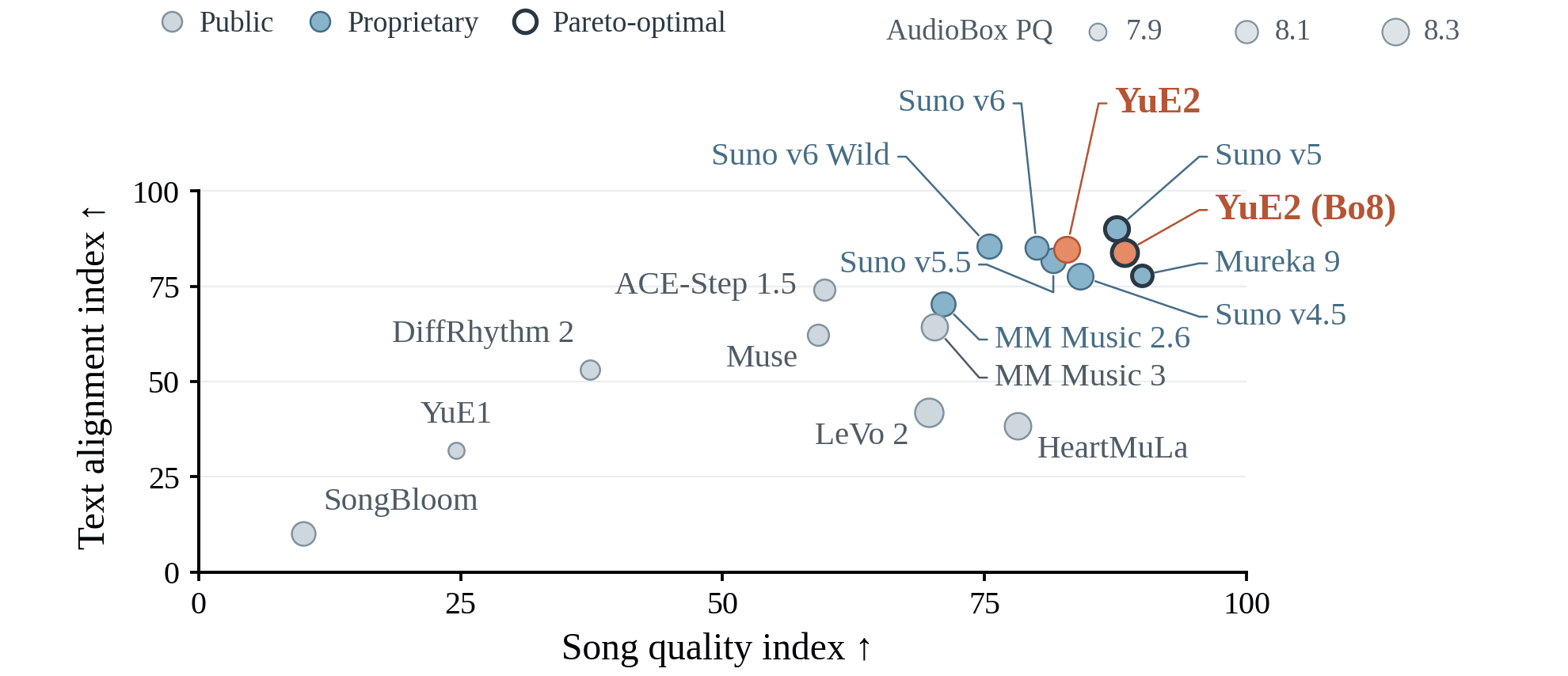
  • Suno v5 still beats standard YuE2 outright on the aggregate at 6.8721, and Suno v4.5 records the lowest error rate in the whole table at 5.80%.
Published scores for YuE2 and Suno across 192 prompts
SettingSongBench avgSongEval avgPrompt followPER
YuE2, best-of-86.96324.29604.70099.79%
YuE2, standard6.73164.26254.68198.44%
Suno v56.87214.35794.59078.10%
Suno v5.56.71504.21524.59145.96%
Suno V66.55624.30864.62587.58%
Suno V6 Wild6.41954.21994.58987.45%
  • Standard YuE2 is fourth on the aggregate, not first. Mureka 9 (6.9377) and Suno v5 (6.8721) sit above it. Only the best-of-8 row tops the table.
  • Best-of-8 means eight generations were produced and one was selected. It is roughly eight times the work for one keeper, and no single credit spend reproduces it.
  • Suno V6 is the lowest-scoring Suno release in this comparison. Three older versions score higher on the aggregate, so "beats V6" is a narrower claim than it sounds.
  • Scoring is automatic. Nothing here measures whether a listener prefers the result, the authors state the small gaps are not tests of significance, and the comparison is documented rather than matched for compute.
  • Both YuE2 rows used the benchmark evaluation decoder, which is not the decoder used for everyday listening. Benchmark audio and studio audio are not the same pipeline.
Chart of YuE2 and Suno V6 song quality and text alignment across 192 prompts
Song quality against text alignment across 192 prompts. Bo8 marks the best-of-8 setting. Saved from the 12 September 2026 comparison figure. Download the chart as PDF.

Generate another version, or edit the one you have

Everything else follows from this. One product puts control before generation, the other puts it after.

YuE2: decide, then generate

Paste the lyric, describe genre, voice, instruments and mood, and optionally attach one reference recording. Text to Music costs 3 credits; Music to Music costs 4. A different idea means a new full version rather than a patch, which is why the jazz rewrite above matters: same words, same seed, a completely different arrangement. This browser studio does not include a score or piano-roll editor.

Suno V6: generate, then talk to it

Suno shipped V6, V6 Wild and V6 Mini on 9 September 2026, with the flagship aimed at precise results and Wild at exploration. After a draft you can rewrite one section in plain language, change a single lyric without rebuilding the vocal, combine sources into a mashup, or sample a riff at a timestamp. Max Mode costs more credits and is aimed at longer songs and covers that must stay close to the source.

Neither approach is strictly better. Fixing one bad bar is genuinely easier on a subscription. Exploring five arrangements of the same finished lyric is cheaper when each attempt is a few credits and the files come home with you.

What a keeper actually costs

Compare the cost of songs you keep, not the cost of songs you generate. This is where the two pricing models diverge most sharply, and it is the part most comparisons skip.

Pricing, downloads and commercial use compared
What you are comparingYuE2Suno V6
Entry5 free credits, generation and listening includedA free tier with daily credits; full-length free output runs on the smaller V6 Mini model
Paid shapeOne-time packs: $9.90 for 99 credits, $29.90 for 370, $49.90 for 700. No monthly subscriptionMonthly subscription, around $10 for Pro and $30 for Premier
Per song3 credits for Text to Music, 4 for Music to MusicA standard run costs 10 credits and returns two songs
DownloadsStarter includes downloads. Basic and Plus download without a monthly limitCapped per month on paid plans, commonly cited as about 20 on Pro and 60 on Premier
Commercial useCommercial licence included on Starter, Basic and Plus. Free is personal use onlyCommercial rights on songs generated while subscribed

The practical difference shows up in one habit. If you generate a dozen candidates and keep two, a monthly download cap eventually decides how much of your own work you can take away. Our Basic and Plus packs do not meter that, and the commercial licence travels with the paid pack rather than with an active subscription. Suno prices and caps change; check their pricing page before you pay. Suno pricing.

Starter

$9.9

One-time · 99 credits

$0.10 / credit

  • 33 songs
  • 33 music generations
  • 99 lyrics generations
  • 2 tasks at a time
  • Commercial License Included
  • AI Music Generator
  • AI Lyrics Generator
  • Remix & Edit Song
  • Advanced Music Analyzer
  • AI Singing Voice Model Training
  • Music Download
  • Email Support

Basic

$29.9

One-time · 370 credits

$0.08 / credit (approx.)

  • 123 songs
  • 123 music generations
  • 5 tasks at a time
  • Commercial License Included
  • AI Music Generator
  • AI Lyrics Generator
  • Remix & Edit Song
  • Advanced Music Analyzer
  • AI Singing Voice Model Training
  • Unlimited Download
  • 24/7 email support

Plus

Most popular

$49.9

One-time · 700 credits

$0.07 / credit (approx.)

  • 233 songs
  • 233 music generations
  • 10 tasks at a time
  • Commercial License Included
  • AI Music Generator
  • AI Lyrics Generator
  • Remix & Edit Song
  • Advanced Music Analyzer
  • AI Singing Voice Model Training
  • Unlimited Download
  • 24/7 email support

Choose by what you are making

Choose YuE2 when

  • You already have a lyric and want to hear several complete arrangements of it.
  • You would rather buy credits once than keep a subscription alive.
  • You intend to download and use the files, and an unlimited-download pack with a commercial licence matters more than in-app editing.
  • Your song is not in English and you want to audition pronunciation before committing.
  • You want to attach one reference recording and explore a new rendition of an idea.

Choose Suno V6 when

  • The song mostly works and you need to fix one chorus, one line or one bar.
  • You are starting from an image, a video or a vague mood rather than finished words.
  • Mashups, sampling a riff or pulling stems are part of how you finish a track.
  • The result depends on large dramatic production, where the reported polish gap is widest.
  • You would rather pay monthly for a toolbox than per song for output.

Plenty of people will use both: draft and re-voice cheaply on credits, then take the version you like into a subscription studio for surgical edits.

Questions people ask before switching

Method and sources

  • Scores, metrics and selection protocols: the 12 September 2026 WildSongBench comparison published with the YuE2-3B model card, covering 192 prompts and 17 settings across nine automatic metrics.
  • Suno product behaviour and model line-up: Introducing v6, 9 September 2026, plus Suno’s pricing and help pages for credits, download caps and commercial rights.
  • Genre-level listening impressions attributed on this page to others: a 17 September 2026 published A/B comparison and early community reports.
  • Our own measurements: the YuE2 review’s twelve works at seed 831001, with audio length, inference time, GPU memory, automatic transcript discrepancy, integrated loudness and true peak.
  • Studio prices, credit costs, download and licence terms: this site’s pricing page and service terms. Suno figures last checked 20 September 2026; confirm both before you pay.
Is YuE2 better than Suno V6?

On the published aggregate, yes: 6.7316 standard and 6.9632 best-of-8 against 6.5562. But the same comparison gives Suno V6 a higher SongEval average, higher caption alignment and a lower pronunciation error rate of 7.58% against 8.44%. It leads on the headline number, not on every measure, and no listener vote is involved.

Why does Suno V6 score below Suno v5 in the table?

Because V6 is the lowest-scoring Suno release in this particular comparison. Suno v5 reaches 6.8721, v5.5 reaches 6.7150 and v4.5 reaches 6.6995, all above V6 at 6.5562. Anyone claiming a clean win over Suno by pointing at the V6 row is pointing at Suno’s weakest row here.

Does one generation on this site equal the benchmark score?

No, and we would rather say so. The standard row selects the better of two generations and best-of-8 selects from eight, using a quality dimension to choose. The benchmark also used the evaluation decoder rather than the everyday one. A single credit spend returns the song from that request. Listen on free credits before buying a larger pack.

Will a cover sound like the original song?

Not note for note. Music to Music takes one reference recording plus lyrics and a style prompt and guides a new rendition. The published cover test shows song identity collapsing from 0.647 to 0.006 when no musical structure is supplied, which is the honest limit of prompting alone. The jazz rewrite on this page keeps the words and changes only the arrangement.

How do the two pricing models compare?

YuE2 charges 3 credits for Text to Music and 4 for Music to Music from one-time packs starting at $9.90, with no monthly fee. Suno charges a monthly subscription and lists 10 credits for a standard run that returns two songs. The units are not equivalent, so compare how many songs you expect to keep rather than how many you generate.

Which plan lets me download and sell the result?

Starter, Basic and Plus include a commercial licence. Starter includes music downloads; Basic and Plus download without a monthly limit. The Free plan covers generation and listening for personal use and does not include downloads. Suno grants commercial rights on songs generated while subscribed, with monthly download caps by plan.

Where can I hear more before deciding?

The review documents twelve English test works with measured timings and transcript checks. The song library holds 99 recordings across 69 genres and 6 languages plus 11 cover and editing demos. None of it is a Suno catalogue, and none of it is customer work.

Bring the words. Hear the version you were imagining.

Five free credits to start, and no monthly subscription to keep alive. Paid packs add downloads and a commercial licence.

Text to Music costs 3 credits. Music to Music costs 4.