It writes the score first, then performs it
Symbolic planning gives the model a musical plan before audio synthesis. In the official workflow, melody and chord symbols can be inspected between those stages.
 YuE2
YuE25 free credits to start. Sign in to generate your first song.
YuE2 is an open-weight music model that turns your lyrics and a style prompt into a full song with vocals. Its official workflow also gives you an editable score. Create audio in this browser studio; explore score editing in the model workflow below.
YuE2 is an open music generation model that turns written lyrics and a style description into a complete song with vocals and accompaniment, by first composing an editable musical score.

YuE2 comes from M·A·P (Multimodal Art Projection). The generation model is called YuE2-3B. You will also see it written as YuE2 AI, which refers to the same music model.
YuE2 adds a step called symbolic planning: it writes melody and chords as a readable score in ABC notation before rendering audio. In the official model workflow, you can inspect that score, change a chord and render another version. That middle step makes the composition part of the workflow, rather than leaving you with audio alone.
This site provides an online studio for lyrics, style prompts and reference audio. The editable-score features described below belong to the official model workflow; this studio does not provide a score editor or score downloads. Source: YuE2 model card.
The model separates the composition from the performance, so melody and harmony can become explicit inputs in an editing workflow.
Symbolic planning gives the model a musical plan before audio synthesis. In the official workflow, melody and chord symbols can be inspected between those stages.
Change a chord progression or revise a phrase in the ABC score, then generate a new rendition. This is a model-level workflow for people who want to work on the composition directly.
The official API supports melody-and-chord planning, melody-only planning and generation without a symbolic plan. Our browser composer uses the service's generation workflow and does not expose a planning-mode selector.
The official cover workflow uses a transcribed melody and a new style prompt. In this studio, YuE2 AI Music Cover provides reference-audio generation with lyrics and style.
An external agent can help revise a score, style and lyrics before the model renders another version. The official editing demonstration follows a song through several musical revisions; an editing agent is not included in this studio.
Original songs from your words, reference-guided renditions, and score-based revisions through the official model workflow.
You have a verse and a chorus and want to hear them sung. Paste the lyrics, describe an arrangement and listen to the idea as a song. Start with the music generator.
The official demos include Auld Lang Syne as jazz-funk and Jingle Bells as heavy metal. They illustrate how a familiar tune can be given a different setting. Our online cover page uses a reference recording to guide a new generation.
With the official score-based workflow, you can change harmony, adapt a phrase or revise the style before rendering again. A new rendition can vary beyond the requested change; keeping a seed does not guarantee that every other detail stays identical.
Listen to six examples across English, Chinese, Japanese and Spanish. Compare the voices, phrasing and arrangements to find a direction for your own song.

Electronic textures meet a high-energy rock direction. Follow the vocal against the backing rhythm.

A dance-oriented track with Chinese vocals. Listen for the interplay between the bass and sung phrases.

A groove-led Japanese selection. Hear how the rhythmic feel carries the voice from phrase to phrase.

A quieter arrangement with Japanese vocals. Listen to the space around the singing and instrumental detail.

An English guitar-led song. Follow the transitions to hear how the arrangement develops.

A Spanish selection with a contrasting rhythmic character. Compare its phrasing with the other examples.
Official model examples published by the YuE2 project, not customer tracks made in this studio. Source: official YuE2 demos
YuE2 suits people who care what the song is made of, not only how the first take sounds. Different workflows suit different starting points.
Paste the lyrics, describe the arrangement and listen. The online studio gives you a way to explore a vocal demo before planning a recording session. Review the phrasing and rewrite the words or musical direction for another attempt.
The official model's score workflow lets you inspect melody and harmony, revise the composition and render another version. Use that workflow when the notes themselves matter; use this studio when you want an audio draft from lyrics, style and a reference.
YuE2 publishes downloadable weights, evaluation material and separate planning and synthesis interfaces. These give you a way to examine the model and build a workflow around its stages. Explore the model review.
The YuE2 team's September 12, 2026 comparison reports strengths and tradeoffs across 192 WildSongBench prompts. These are model evaluations, not guarantees for this online service.
| Measure | YuE2 | Suno v6 |
|---|---|---|
| Musicality | 5.9075 | 5.6558 |
| SongBench average | 6.7316 | 6.5562 |
| Prompt adherence (Q3O) | 4.6819 | 4.6258 |
| Pronunciation errors (PER, lower is better) | 8.44% | 7.58% |
| Text alignment (AllMusicCaps) | 0.4054 | 0.4305 |
In this reported comparison, YuE2 scores higher on musicality and SongBench average, while Suno v6 has fewer pronunciation errors and higher AllMusicCaps text alignment. The YuE2 row here is the standard result, not the separate best-of-8 result.
Listen to examples as well as reading the numbers. A benchmark average cannot tell you how a particular lyric, language or arrangement will turn out. Source: published benchmark and evaluation protocols.
The useful distinction is whether you want a quick audio draft or a workflow that lets you work on the composition itself.
Bring your lyrics, set the style, choose an audio format and follow the generation. These four steps show the browser studio workflow.
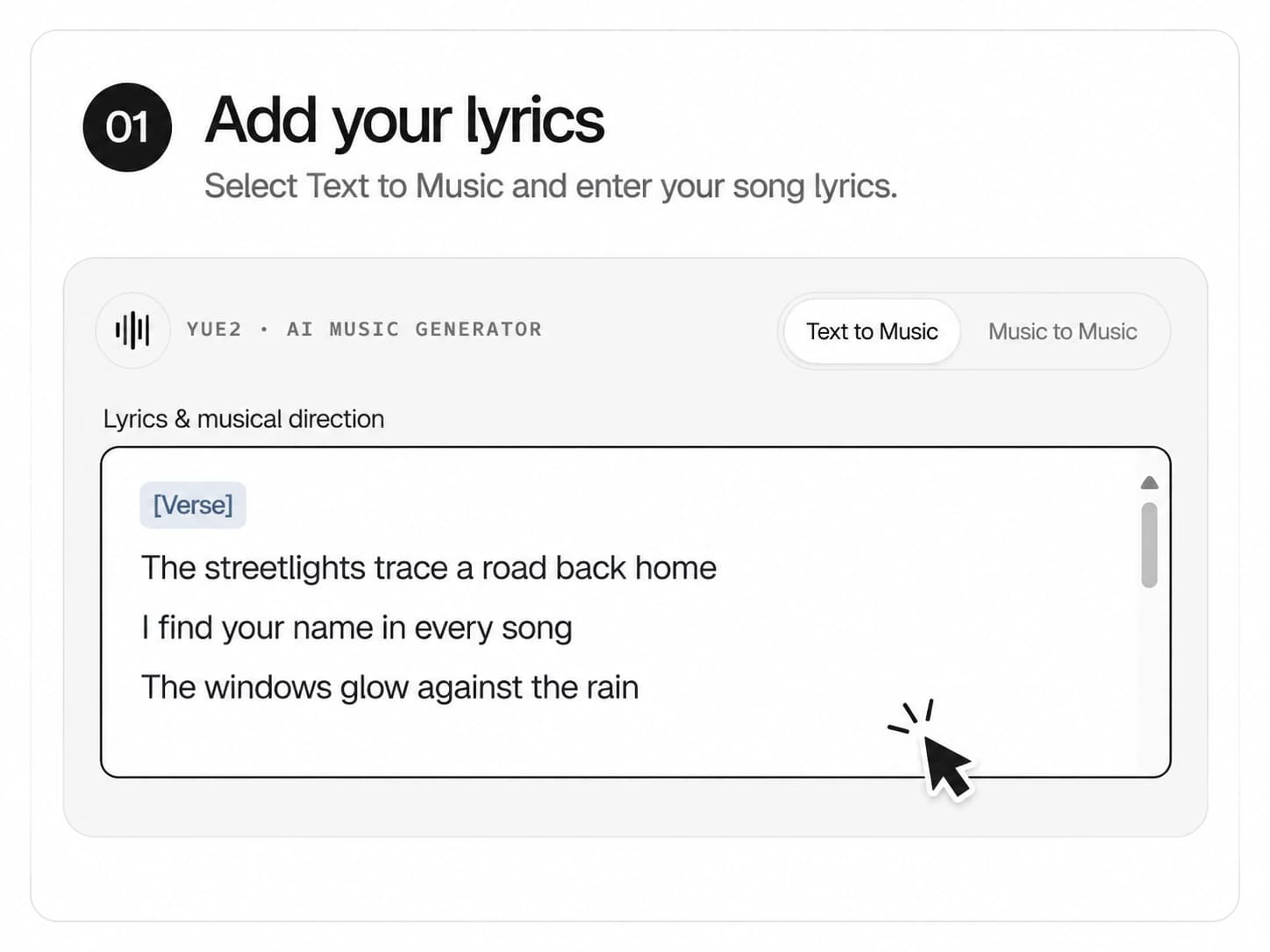
Select Text to Music and paste the words you want performed. Label sections such as Verse, Chorus and Bridge, and leave space between them. If a recording is part of your brief, choose Music to Music and upload a reference as well.
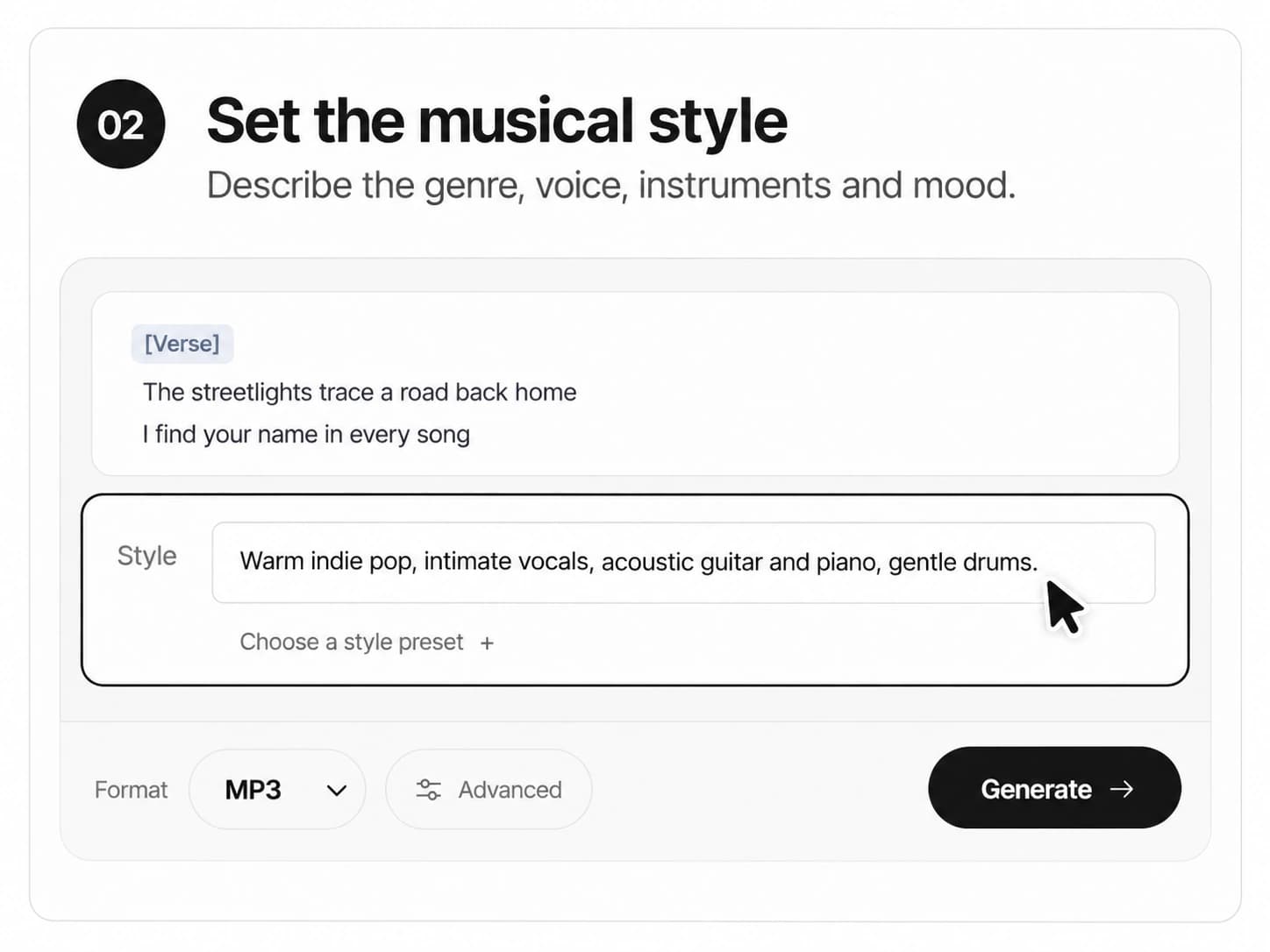
Describe the genre, vocal character, main instruments and mood. Start with a preset or write a focused brief, such as warm indie pop with acoustic guitar, piano and gentle drums. Keep arrangement instructions in Style, separate from the lyrics.
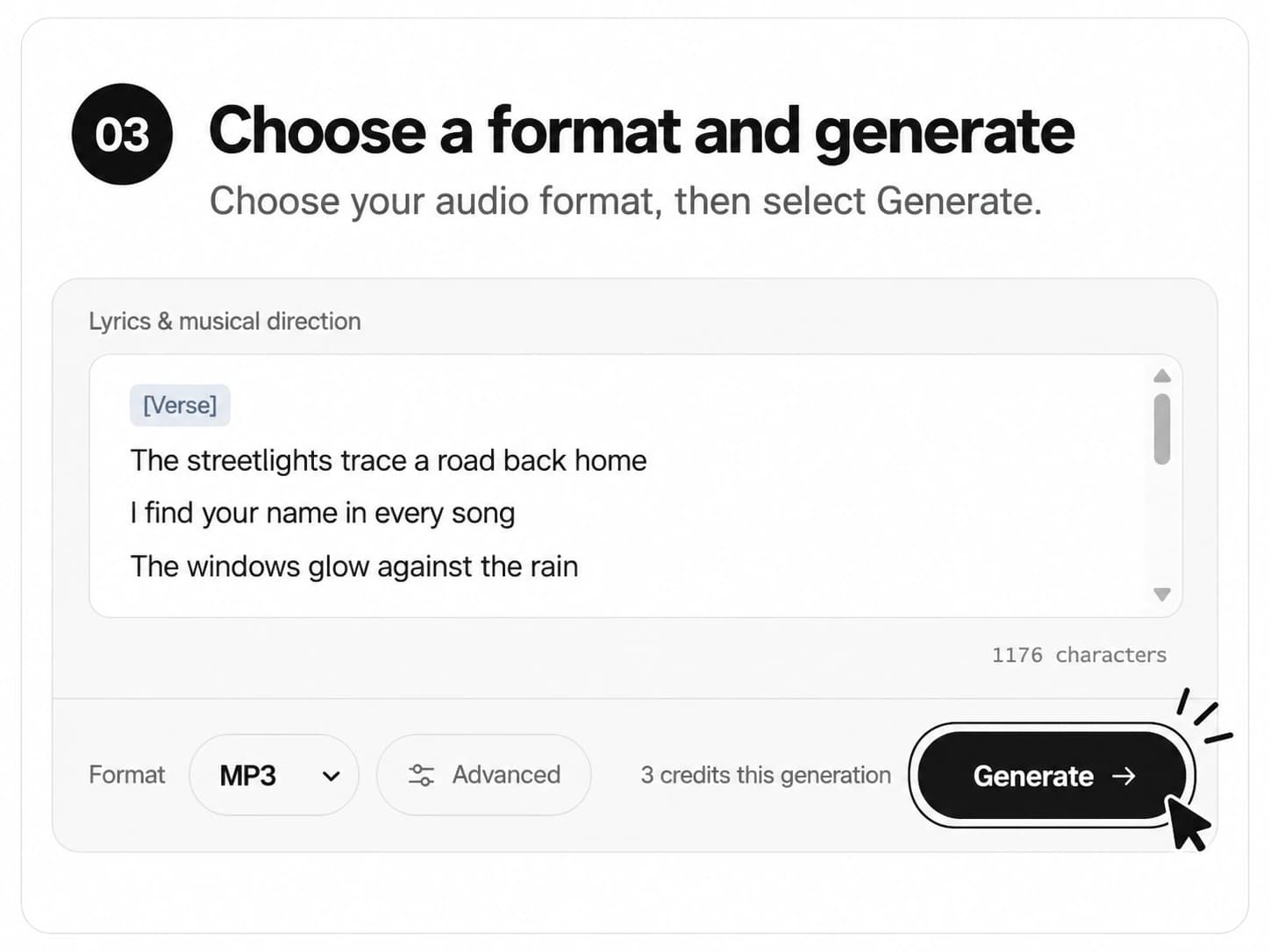
Choose MP3, WAV or FLAC, sign in and check your credits before selecting Generate. Text to Music uses 3 credits; Music to Music uses 4. Each new generation uses credits.
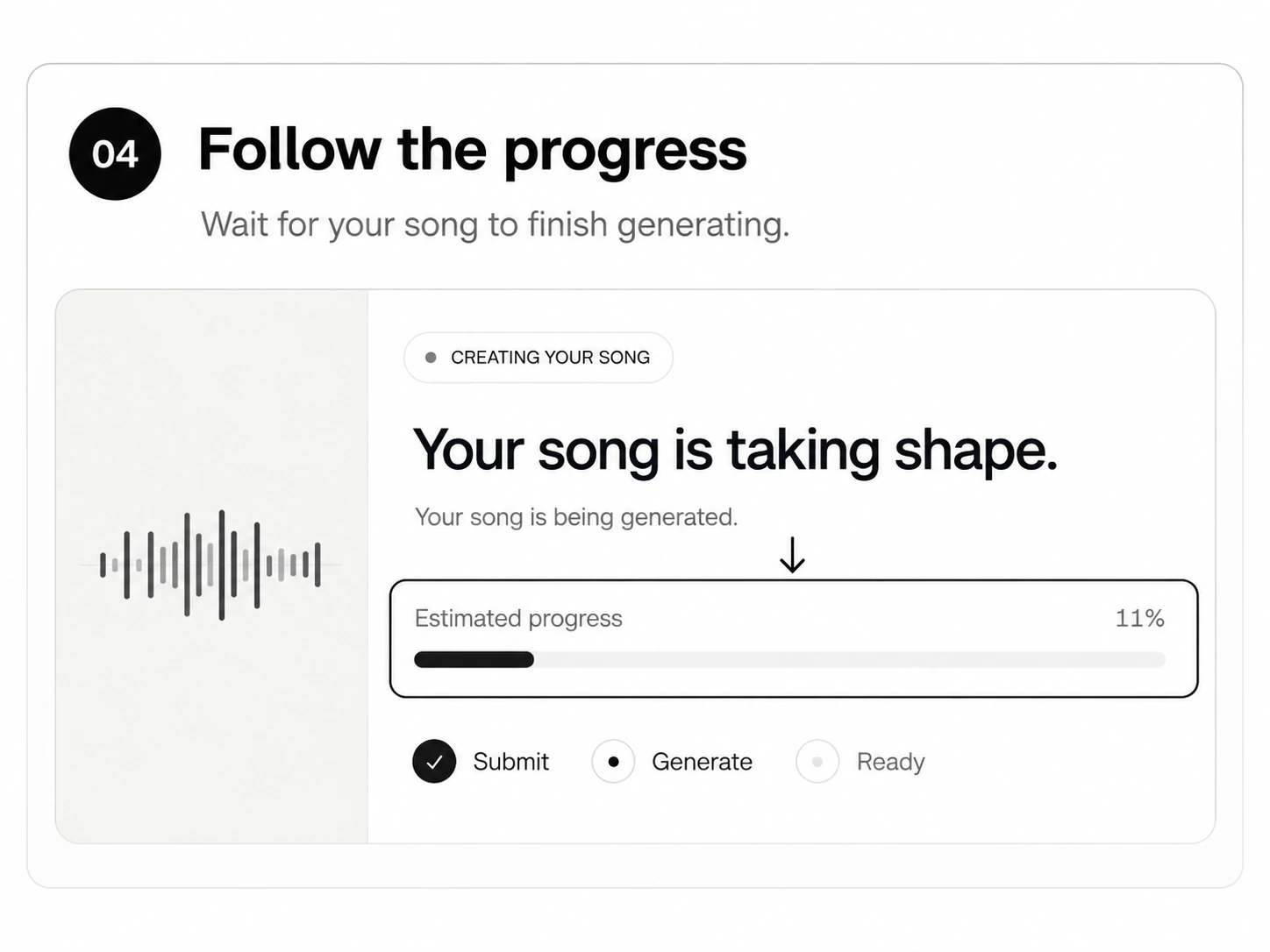
The estimated progress bar moves to 95% over about 60 seconds, then waits for the actual result. It is a visual estimate, not a measurement of model completion. When your song is ready, play it on the page and decide what to try next. Downloads are available with paid plans.
For melody and chord editing outside this studio, see the score-editing experiments in our YuE2 review.
Start with 5 free credits. Text to Music uses 3 credits per generation; Music to Music uses 4. Paid packs are one-time purchases, with no monthly subscription. The Free plan includes generation and listening; paid plans include downloads.
$0
One-time · 5 credits
A first step for your music
$9.9
One-time · 99 credits
$0.10 / credit
$29.9
One-time · 370 credits
$0.08 / credit (approx.)
$49.9
One-time · 700 credits
$0.07 / credit (approx.)
YuE2 is an open music generation model from M-A-P. It turns lyrics and a style prompt into songs with vocals and accompaniment, with a symbolic planning workflow that can make melody and chords editable before audio rendering.
The Free plan includes 5 credits. One-time packs start at $9.90 for 99 credits; Basic is $29.90 for 370 and Plus is $49.90 for 700. Text to Music uses 3 credits and Music to Music uses 4. Paid plans include downloads.
In the YuE2 team's September 12, 2026 WildSongBench comparison, standard YuE2 scores 5.9075 on musicality against 5.6558 for Suno v6. Suno v6 has fewer pronunciation errors: 7.58% against 8.44%. These reported model results do not guarantee individual studio outputs.
The official local quick start specifies Linux, Python 3.10+ and a 24 GB NVIDIA GPU with BF16 support. Community ComfyUI workflows are separate integrations. This online studio does not require either installation.
The six official examples on this homepage include English, Chinese, Japanese and Spanish. They demonstrate the model rather than customer work from this studio. Pronunciation and phrasing should be reviewed for each generated song.
The official model supports covers guided by a transcribed score. Here, Music to Music accepts one reference recording, lyrics and a style prompt to guide another rendition. The studio does not expose a score editor or guarantee an unchanged melody.
Symbolic planning is the stage where YuE2 writes a melody and chords before rendering audio. The official workflow supports full planning, melody-only planning and direct generation. This browser composer does not expose these planning settings or editable score exports.
Start with lyrics and a description of the sound. Organize the words into sections and put musical directions in Style. Sign in to generate online. Choose MP3, WAV or FLAC and listen on the page; downloads require a paid plan.
Bring the words you want to hear. Choose a musical direction and turn the idea into a song. Start with 5 free credits.